Latest from Queryloop
Stay updated with our latest research findings, product developments, and insights into AI optimization
Stay updated with our latest research findings, product developments, and insights into AI optimization
Learn why creating demo RAG applications is easy, but building production-grade systems is exponentially harder, and how Queryloop solves these challenges.
Creating a demo for Retrieval Augmented Generation (RAG) is easy, but building a production-grade app is 10x harder—if not more. For every blog or tutorial claiming you can launch a RAG app in under an hour, there are hundreds discussing the complexities of building LLM and RAG systems that reliably deliver acceptable accuracy, latency, and cost.
We see these challenges in practice. OpenAI, on their Devday, explained that while building a RAG pipeline for an enterprise client, they started with a baseline accuracy of 45%. They then experimented—through a long process of trial and error—with techniques like Hypothetical Document Embeddings, fine-tuning embeddings, and adjusting chunk sizes.
Nvidia recently noted that there are 15 different control points in a RAG pipeline, each impacting the final result. Factors such as query rewriting strategy, chunk size, pre-processing technique, metadata enrichment, reranking, and LLM selection all matter.
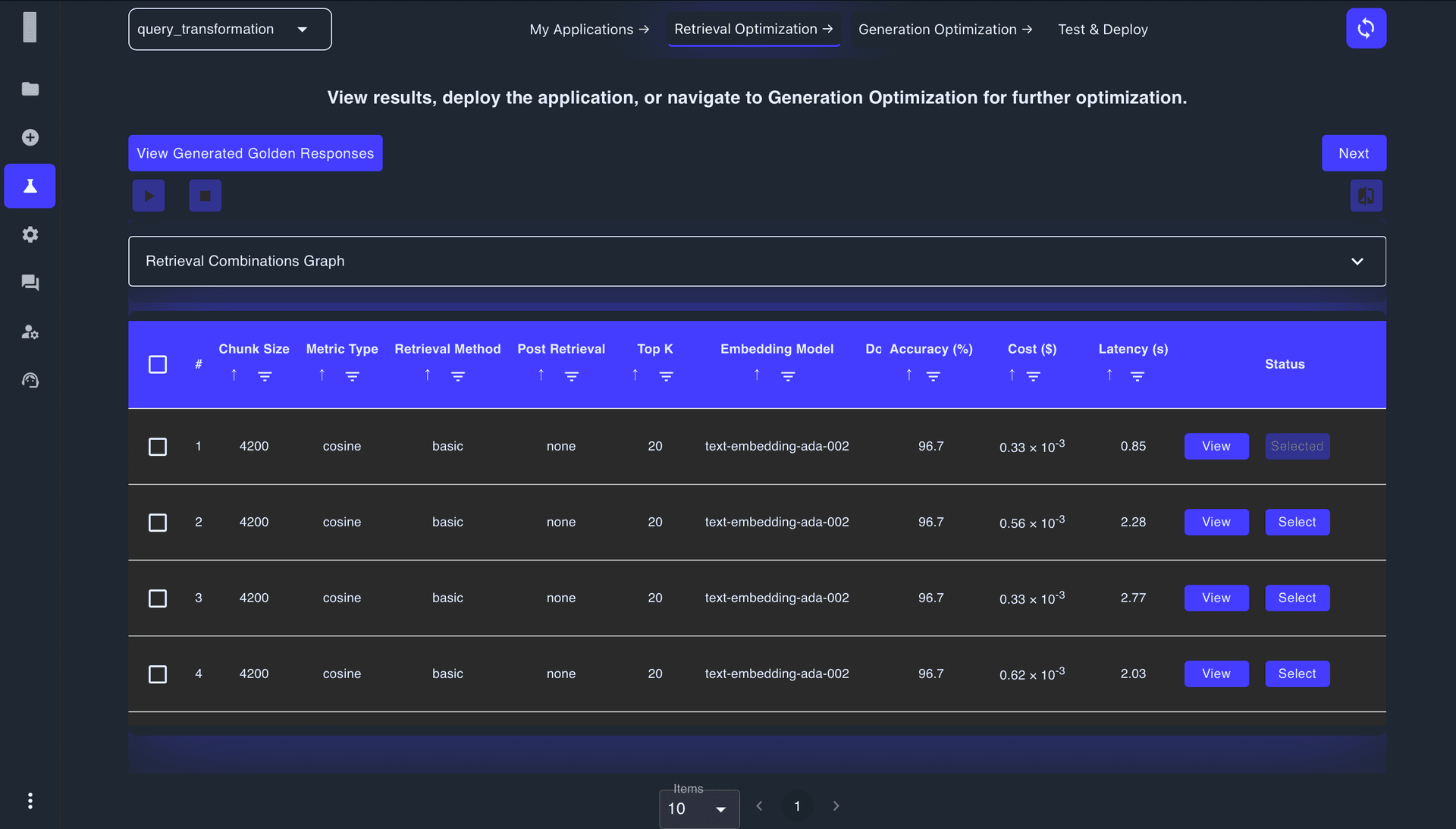
For evaluation of each combination, we have built our own evaluation methods that improve upon open source approaches such as RAGAS.
Customers like Guidelinebuddy have already experienced our seamless app building workflow and successfully deployed optimal RAG applications with Queryloop.
Learn how Queryloop automates RAG optimization through systematic testing of parameter combinations to maximize accuracy, minimize latency, and control costs for complex document analysis.
Discover how we compared 8 different parsing solutions to tackle hierarchical tables, merged cells, and horizontally tiled tables in PDFs for RAG applications.